

We have a trail camera set up on a tree in our yard to monitor creatures that raid our bird feeders—on a regular basis. We’re currently hosting a mama racoon (affectionally known as Fat Mama because of her girth) who shows up with three of her youngsters. We also have a family of skunks which have taken up residence under our deck. This mama has five (!) little ones that frolic and generally enjoy the yard and area beneath the feeders in case there’s some spillage. Then there are the white-tail deer which, when not consuming Susan’s plants, bump against the feeder tray to knock out whatever the birds have not consumed. So far, we’ve all lived in harmony and the plan, at least on the part of we humans, is to keep it that way.
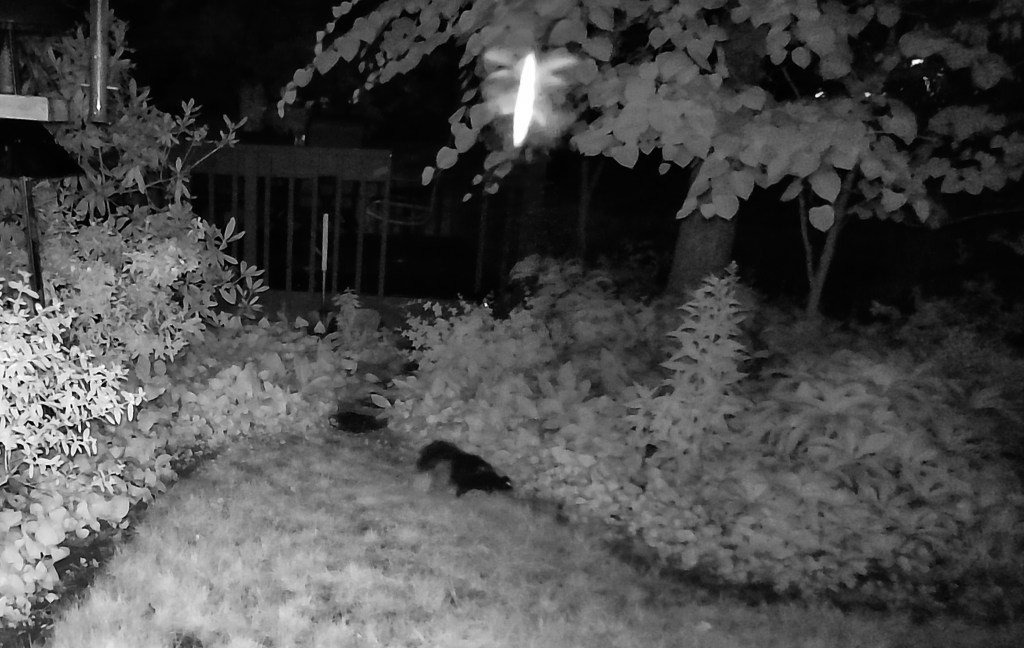
Last night, however, was a first capture for the trail cam. It took the analysis skills of a CIA photo analyst to noodle this one out. It’s a picture of a firefly, or lightning bug, if you prefer. The camera is triggered by motion so occasionally we get images of falling leaves, sticks, even rain drops during a storm.
Because of chemical applications and mowing of lawns, there are fewer lightning bugs around these days than ever before.
So, what turns a lightning bug on? The light of a firefly is a chemical reaction caused by an organic compound – luciferin – in their abdomens. As air rushes into a firefly’s abdomen, it reacts with the luciferin. Consequently, it causes a chemical reaction that gives off the firefly’s familiar glow. Each firefly species flashes differently. This pattern helps them search for potential mating partners. Male fireflies use a specific flashing pattern while flying in the air finding a female. Many lightning bugs flash only once, while others do so around nine to 10 times.
Lightning bug brightens the way for one of our occasional skunk visitors.
 Witt’s End