

Imaging the International Space Station (ISS) is one of those targets plenty of astro photographers attempt—or would like to attempt. Success takes plenty of reliance on things over which we have no control. What we can do is map out the Station’s overpass track (248 miles overhead) and times (thanks to NASA), angle of the moon, or whatever we want in the background, and prepare our gear to the best of our abilities. So, it was last night. I ventured out for my umpteenth attempt at photographing the fast-moving mothership, which falls at a rate of about 17,900 miles per hour. Yes, falls. It actually travels in an orbit at a specific altitude, as gravity pulls it back toward Earth. It falls at about the same speed as the Earth turns, thus never getting any closer. (Ultra over-simplification Clyde, get on with the story.)
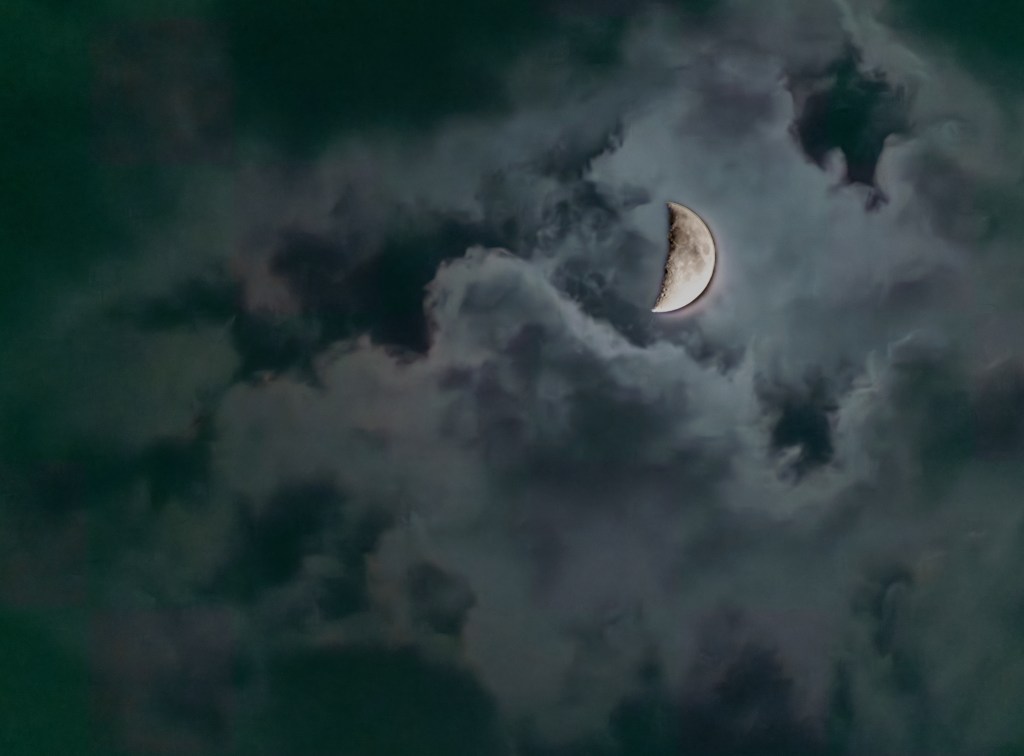
Prepared as I was, the weather had other plans of which it did not consult me. At precisely 21:36 EDT when ISS was about to arise in the sky south of southwest of my position, the clouds rolled in. Uggg. Any sensible astro photographer would have packed up his paraphernalia had headed back inside. Right. Another part of my plan for a happy life is to do the best I can with the tunes I got. Hey, clouds need their picture taken, too.

 Witt’s End