Witt’s End

It's Not About Stories People Tell, It's About …

Imaging the International Space Station (ISS) is one of those targets plenty of astro photographers attempt—or would like to attempt. Success takes plenty of reliance on things over which we have no control. What we can do is map out the Station’s overpass track (248 miles overhead) and times (thanks to NASA), angle of the moon, or whatever we want in the background, and prepare our gear to the best of our abilities. So, it was last night. I ventured out for my umpteenth attempt at photographing the fast-moving mothership, which falls at a rate of about 17,900 miles per hour. Yes, falls. It actually travels in an orbit at a specific altitude, as gravity pulls it back toward Earth. It falls at about the same speed as the Earth turns, thus never getting any closer. (Ultra over-simplification Clyde, get on with the story.)

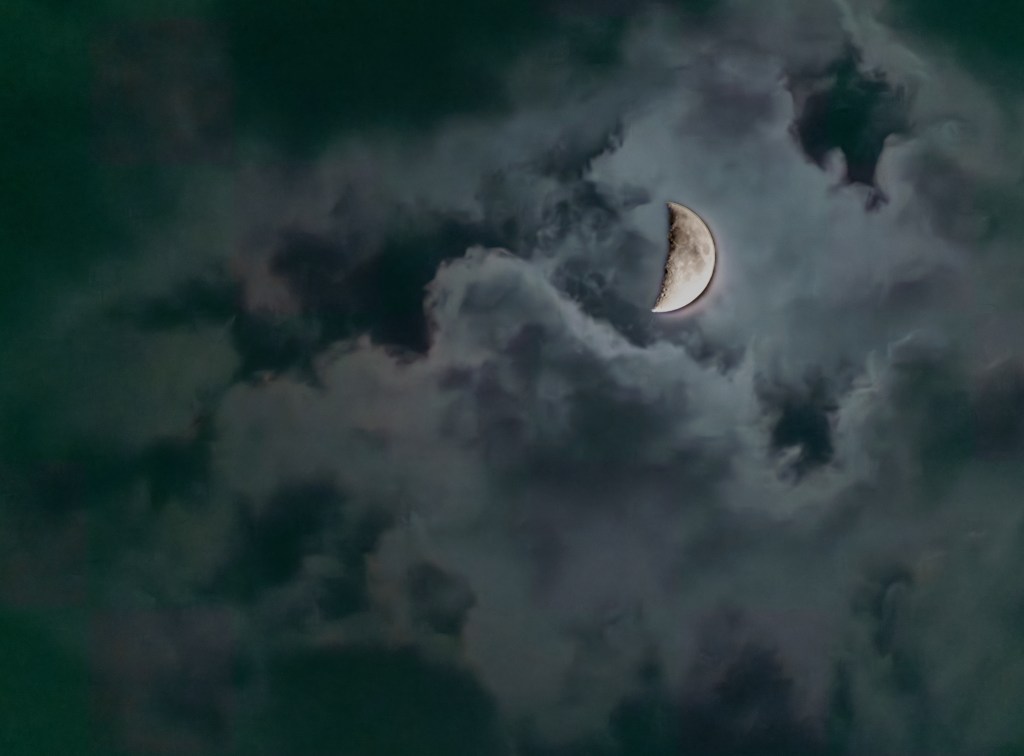
Prepared as I was, the weather had other plans of which it did not consult me. At precisely 21:36 EDT when ISS was about to arise in the sky south of southwest of my position, the clouds rolled in. Uggg. Any sensible astro photographer would have packed up his paraphernalia had headed back inside. Right. Another part of my plan for a happy life is to do the best I can with the tunes I got. Hey, clouds need their picture taken, too.

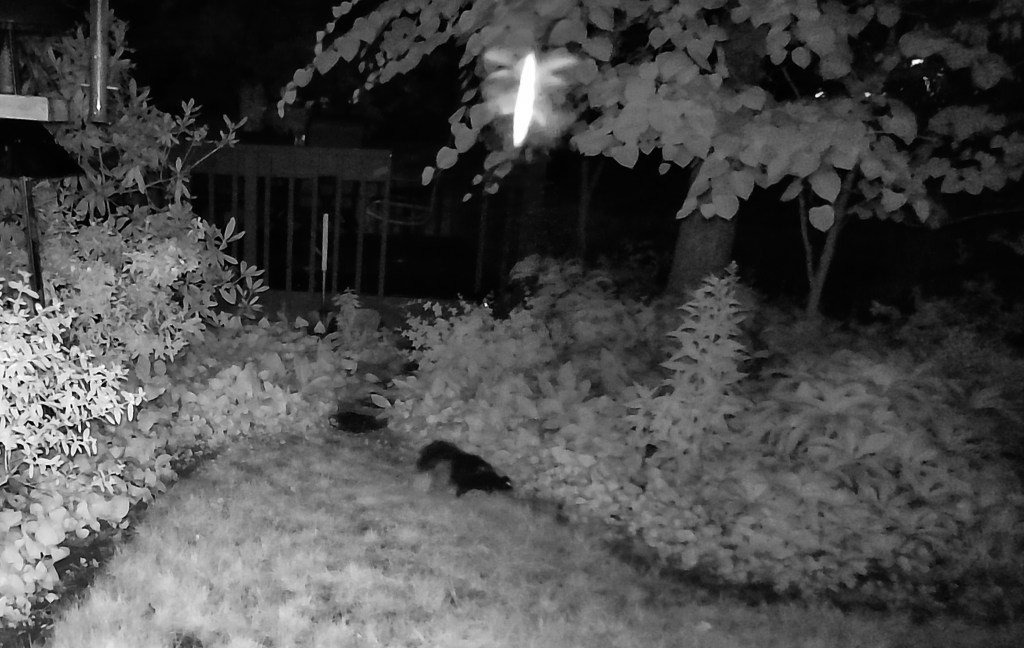
We have a trail camera set up on a tree in our yard to monitor creatures that raid our bird feeders—on a regular basis. We’re currently hosting a mama racoon (affectionally known as Fat Mama because of her girth) who shows up with three of her youngsters. We also have a family of skunks which have taken up residence under our deck. This mama has five (!) little ones that frolic and generally enjoy the yard and area beneath the feeders in case there’s some spillage. Then there are the white-tail deer which, when not consuming Susan’s plants, bump against the feeder tray to knock out whatever the birds have not consumed. So far, we’ve all lived in harmony and the plan, at least on the part of we humans, is to keep it that way.

Last night, however, was a first capture for the trail cam. It took the analysis skills of a CIA photo analyst to noodle this one out. It’s a picture of a firefly, or lightning bug, if you prefer. The camera is triggered by motion so occasionally we get images of falling leaves, sticks, even rain drops during a storm.

Because of chemical applications and mowing of lawns, there are fewer lightning bugs around these days than ever before.

So, what turns a lightning bug on? The light of a firefly is a chemical reaction caused by an organic compound – luciferin – in their abdomens. As air rushes into a firefly’s abdomen, it reacts with the luciferin. Consequently, it causes a chemical reaction that gives off the firefly’s familiar glow. Each firefly species flashes differently. This pattern helps them search for potential mating partners. Male fireflies use a specific flashing pattern while flying in the air finding a female. Many lightning bugs flash only once, while others do so around nine to 10 times.

Lightning bug brightens the way for one of our occasional skunk visitors.

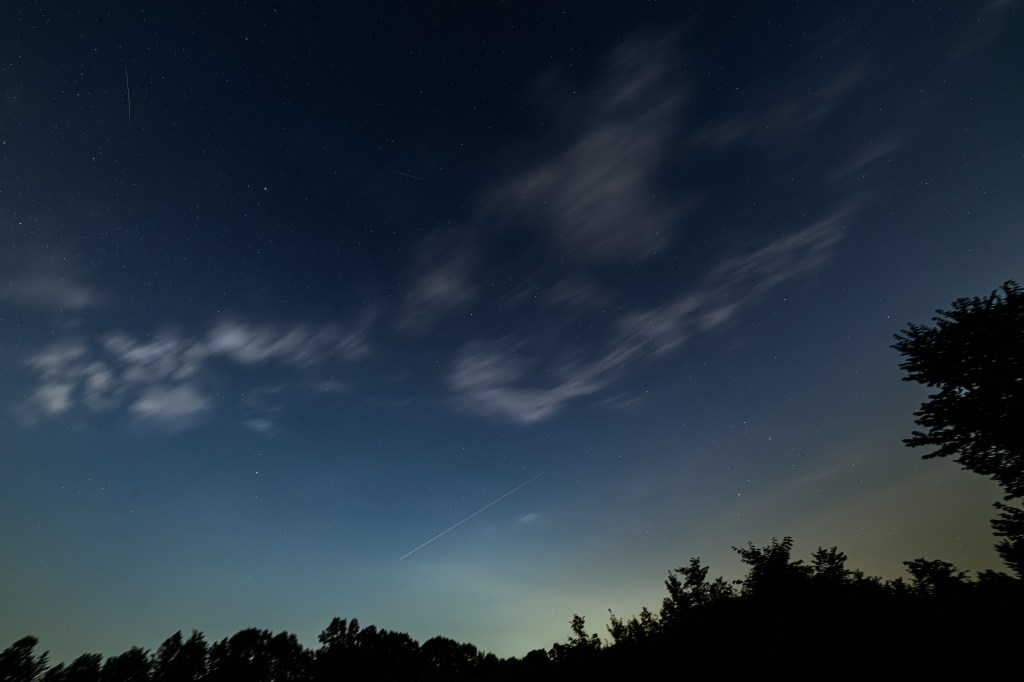
Been a while since I made a run down to the Oak Hill. My goal was to get an image of the International Space Station crossing the Milky Way. I noodled it all out for a couple days and was pleased with the predicted weather forecasts. After greeting all my coyote buddies, with an Eastern Screech-owl singing soprano, I set to work. Alas, although the sky looked clear, there was a lot of upper atmosphere turbulence, thus the Milky Way was not to be seen.

This is a shot in the dark—or right direction. ISS can be seen in the lower central part of the image. It’s a 2-minute-long exposure and the stars are still pin-point sharp thanks to my new star tracker. (You have to look at these on a large monitor or double click to really see the stars.)

I made another attempt at imaging the Milky Way with a long exposure. Here you see a hint of the edge of our galaxy in the lower left of the image. Squint a bit. It’s there. The other big white thingy is a cloud.

Finally, the surprise of the night (thanks to Susan for unraveling the mystery) is this image of an aurora, not seen naked eye. The camera sensor can pick these things up. I was baffled by the purple stripe and green coloring. Susan took one look and said, “It’s an aurora.” Of course. I knew that—not. I thought I was imaging the Swan constellation.

In spite of the sultry temperatures here in the northeast, the strawberries are ripe. At least the Strawberry Moon is ripe. The first lesson most astro photographers learn in this part of the country is to shoot when the sky is clear ’cause it’s only gonna happen about 30% of the time. June 20, the Summer Solstice, promised a full moon–the Strawberry Moon. Well, not exactly. It was 98.something of full. The percentage was about the same as the temperature as I waited for Luna to rise in the spot I had chosen. My calculations were a bit off, however, she did not disappoint. In color she was a pinkish tone, not quite strawberry red, but close enough. According to legend, it’s called the Strawberry Moon because Indigenous people knew the berries would be ripe at about the same time as this full moon–not because of its color. Well, ya coulda fooled me. This was a single image taken through my Explore Scientific ED80CF scope, Nikon D850, ISO 200, 1/125th f4.5. If you look closely, to the left of the moon about an inch away you can see a bat. He accompanied me for a while but I could not catch him in front of the moon.

Well, before the heat wave is able to melt my camera gear, I thought I’d better take advantage of a relatively clear sky last night. I’m currently training myself with the gear I plan to use for upcoming road trips where weight restrictions (the gear, not me) will limit what goes. So last night I worked on aligning my new Star Adventure tracker and mounted the Nikkor 28-300 mm lens. This moon shot is a stack of what started to be nearly 1000 images. I removed the photobombing by planes and satellites and whittled it down to about 750. My stacking program whittled it even more to 647 in selecting the best images. I’m pleased with the results even if it was a bit of overkill. The tracker holds the camera steady as a rock over long periods of time. 300mm, f5.6, 1/250 X647.

And this shot, over the roof of the Big Dipper, is a composite of 35 images. It started out with 150 images but was cut way down to improve the quality. Stacking improved the vast number of stars that are out there, to the point where the dipper is tough to find. I love it! (You might have to double click on the image to see all the stars. 28mm, f5.6, 5 seconds X 35.

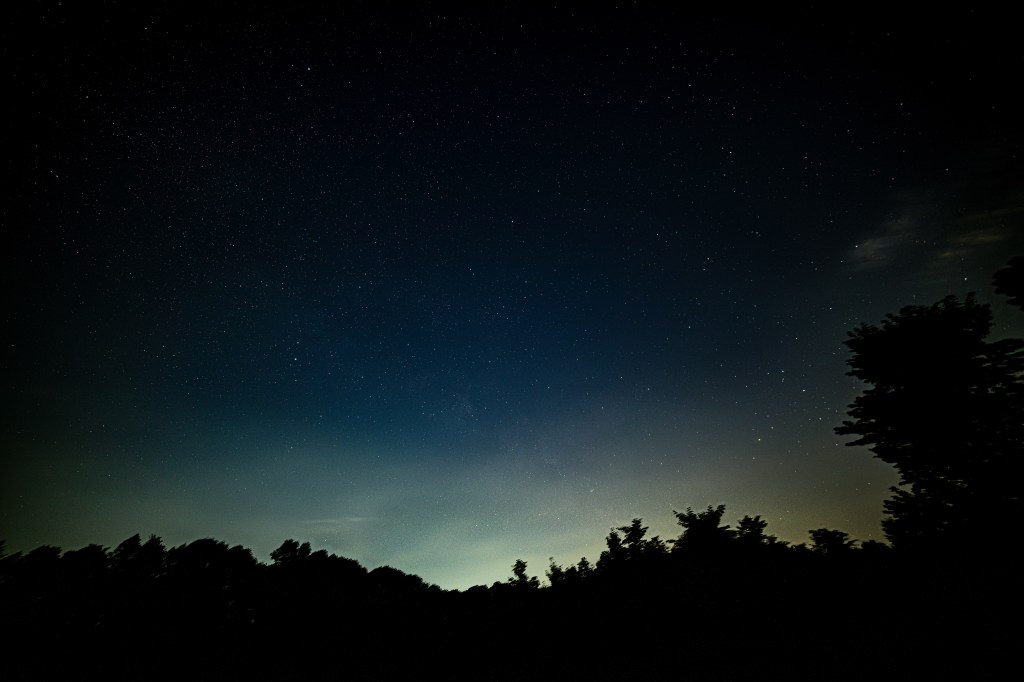
Back from another 5 days at the Cherry Springs Star Party, Cherry Springs, Pennsylvania. I think the threatening weather forecasts kept the crowd down a bit, however, those among the 500 or so in attendance made the best of holes in the clouds. Seeing conditions were marginal since there was so much water vapor in the air. But hey, you do the best you can with the tunes ya got. My current obsession is to get a great panorama image of the Milky Way. I’m still a ways off, however, I’m pleased with what I was able to manage. When you’re standing next to the camera with the instruction book in hand, you can’t always expect the best results. Enjoy these images. A note about the sky: The sky is not always blue or black. In fact, most of the time (in our part of the world) the sky has a green/yellow cast because of a condition called air glow–essentially moisture in the air. We think it’s blue ’cause that’s what we’ve been taught. Go out to a truly dark sky area, let your eyes adjust for 30 minutes and you’ll see what I mean.

This was looking into the galactic center of the Milky Way. Panorama made with Rokinon 14mm lens on Nikon D850. 8 images stitched together in LightRoom Classic.

Milky Way rising. Astronomers use red light to preserve night vision. Single image made with Rokinon 14mm lens on Nikon D850

And a favorite star cluster known as M13, imaged through Celestron Evo 8 telescope, captured by Nikon D850.