Witt’s End

It's Not About Stories People Tell, It's About …

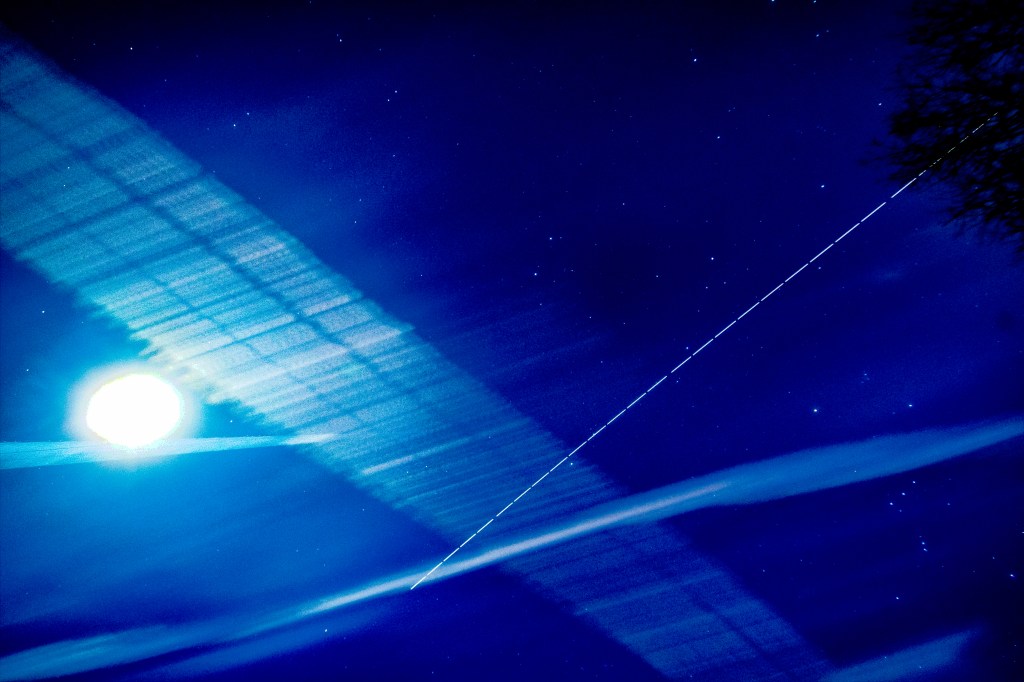
It was a bright and hazy night (I’ve always wanted to use that line). The mission (should I choose to accept) is to image the International Space Station as it plows into the moon. Reliable data from the National Aeronautics Space Administration indicates its path is on prefect trajectory, west northwest to southeast, to intercept the moon, beginning at 8:47 DST (daylight stupid time).

Well, it seems that someone, either the folks driving the ISS or whoever controls the movement of the moon, were a bit off track. With my trusty assistant, Les, and his new camera that is secondarily a cell phone, we watched ISS smoothly move along and miss the moon by several thousand miles. This is good and bad news.

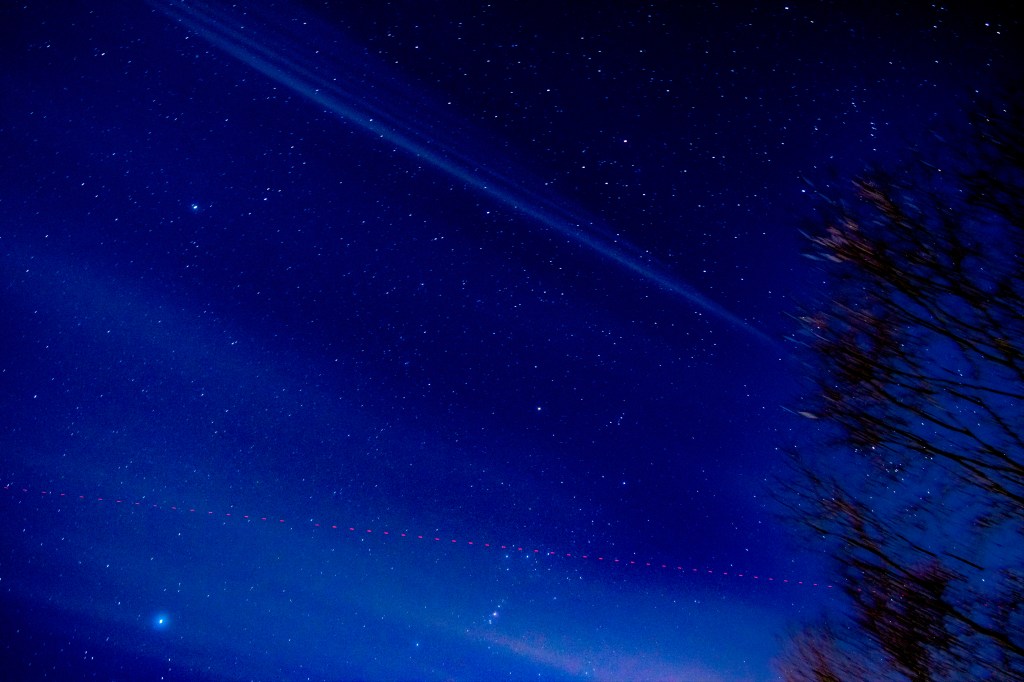
To get this image I stacked 50 images (really only needed about half that many) and used a couple different stacking programs. The lesson here, is, putting the same data into different programs yields different results. Or, garbage in, garbage out. The first image is from the usual stacking program. The fact that ISS presents as a dashed line does not mean “cut here.” The spaces are the fraction of time between exposures. Note how the line stops, for no known reason. The second image I created by putting the same data into the program for imaging comets. Why? Because I could and wanted to see what would happen. Note how the damn contrails are sharper (the moon less so), the image of ISS varies in brightness, and the whole path of ISS is recorded. On the lower right side you can see the constellation of Orion (at least his belt and sword). These images were made with my Nikon D7500 and 10mm ultra wide angle lens. I think the difference of light intensity in the second image is probably accurate. The space station rotates and light is not reflected equally from all sides.

The third image is your bonus for staying with me through all this. It’s a nightscape shot with Orion in the lower center. And, of course, we got photo-bombed by an airplane. The bright star at the lower left is Siris, brightest in the sky.
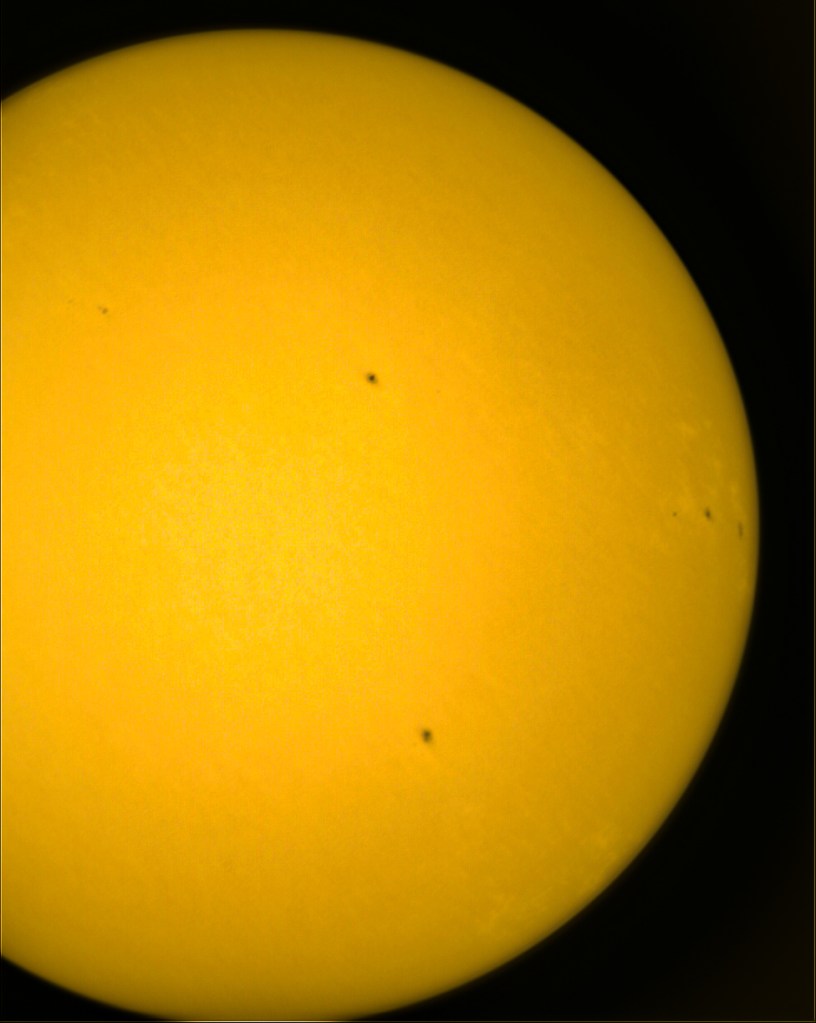
Here’s a little (actually really big) thing to brighten your day. I have some new gear and new software I’ve been waiting to try, however, the sky at night has been less than cooperative. Yesterday I opted to use our favorite star for practice. I know, the composition sucks and the focusing could use a bit of help, too. Those black specs you’re looking at are all part of a rash of flares and eruptions on the sun, any one of which could swallow several planets the size of Earth. Final image created from a stack of several thousand individual images.

So, in case you’ve forgotten what the sun looks like, here ya go. Let’s hope for clear skies, soon.

I’ve heard the Great Orion Nebula referred to as the amateur’s nebula. I guess it gets that tag because it’s easy to find. Maybe so, however, it’s great for a lot of reasons. First, it’s the closest star-producing nebula to Earth, a mere 1,600 light years out there. Its rivers of dust and gas create colorful patterns that challenge the astro photographer. Its central core of four stars, known as the trapezium cluster, are a real challenge to balance their brightness with all that dust and gas they light up. Just one of the four massive stars in the trapezium cluster is 250,000 times more luminous than our star–aka the sun.

Even without a telescope you can enjoy the Great Orion Nebula. The darker the sky area you can find, the better. The constellation Orion (currently in the southwest sky), and his three-star belt is the place to start. Hanging from the left side of the belt (our left, his right) is the scabbard for his sword and within that scabbard is the nebula. It will look like a fuzzy ball, naked eye. With binoculars, however, you begin to see the wispy channels of gas and dust. The image below was made with my Explore Scientific ED80CF scope and Nikon D7500 camera. It’s a composite of 46 images stacked in Deep Sky Stacker software and processed in Adobe Lightroom Classic. The meteor zipping through was a bonus that astro photographers either love or hate. Since it did not cross through my image of the nebula, I welcomed its presence in this night sky image.

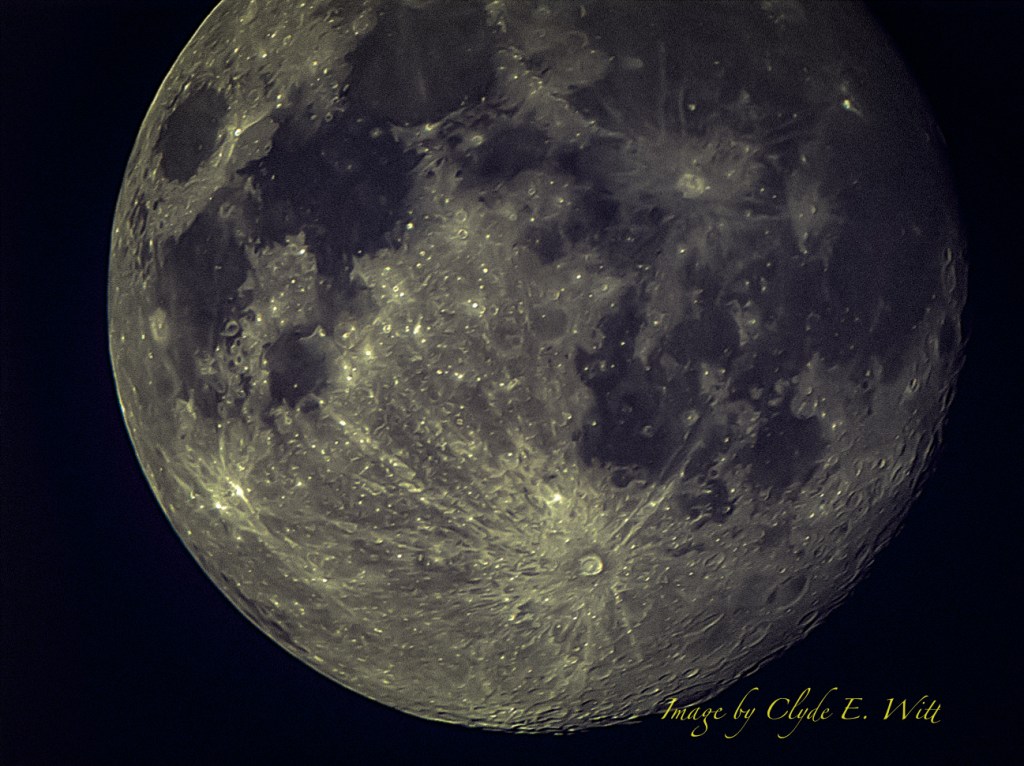
The last full moon of the winter season was/is bright and shiny tonight. I say was/is because here in northeast Ohio you take advantage of clear sky when you can get it. Thus, I was out last night (March 5) photographing the moon because the weather gods were not going to smile upon us for the real full moon, March 6. Okay, not to put too fine a point on this, technically, the moon will be full at 7:42 am on March 7. It looks full for a day on either side of the actual moment of fullness. I was out early in the evening, trying out a new piece of equipment and subsequently whacked off part of the moon’s head. Sorry Luna. From this image, however, you’ll get the picture. It’s made from a stack of about 1,000 separate images shot with my ZWO ASI 224 MC astro camera, and Explore Scientific ED80CF scope, stacked in ASI’s stacking program. Needless to say, I like the results. It was also shot when the moon was low so I picked up some of the golden hour glow.

Why is it called the Worm Moon? Okay, now the rest of the story. Depends on your source of info, however, most almanacs claim it’s because by this time in the calendar year, March, the ground has warmed enough for earth worms to emerge. Maybe. I prefer the story of Captain Jonathan Carver who visited the Naudowessie (Dakota) and other Native American tribes In the 1760s, and wrote that the name Worm Moon refers to a different sort of “worm”—beetle larvae—which begin to emerge from the thawing bark of trees and other winter hideouts at this time. This story seems to have more class than worms crawling out of the ground.

Research brings up a lot of other names for this, the last full moon of winter, Eagle Moon and Goose Moon from the Algonquin, Cree people. Sugar Moon from the Ojibwa has a nice ring (and tastes good). Or, Windy Strong Moon from Pueblo, which refers to windy days in the southwest parts of our country. And one that will never get traction in my part of the country, Sore Eyes Moon from the Dakota, Lakota, and Assiniboine people. The name derives from the blinding rays of sunlight that reflect off the melting snow of late winter. Not much sun around here.

Several years ago, pre-pandemic, I started photographing the iconic State Route 82 bridge spanning the Cuyahoga River. Images of the bridge appear on virtually all of the literature and T-shirts promoting the Cuyahoga Valley National Park–my backyard. Technically known as the Brecksville-Northfield High-Level Bridge, it’s 1,132 feet long and 145 feet high. It’s a five-span open spandrel style structure that begs to be photographed. It was opened in 1931 and has seen minor repairs and renovation over the years. Back in 2012, five-whackos plotted to do some real renovation by blowing up the bridge. Fortunately they were caught and sent to prison.

Here’s my latest image, made a couple nights ago. This was done with a Nikon 10mm ultra wide angle lens on a Nikon D7500. It’s a composite image of 185 separate shots registered and combined in Deep Sky Stacker and LightRoom Classic software. Of course, I see room for improvement–and the bridge isn’t going anywhere, soon.

A large part of the fun, and frustration, of astro photography is that you can rarely see what you’re making images of. If you’re shooting pictures of birds, or buildings, you see them in the viewfinder, do all the composition things, exposures, focusing, etc. With astro photography, what you’re taking pictures of might not even be there! It could be the light is just reaching us here on Earth and the subject, the nebula or galaxy, might be long gone. If you’re imaging the moon or one of the planets, you can be relatively sure it’s still there when you make the image. Another aspect of astro photography is that even while you’re making the shot, anything and everything might fly through the picture. Take the Great Orion Nebula, M42, for example. It’s 1,344 light years out there. To keep that in perspective, light travels at a rate of 186,000 miles per second, or, 5.88 trillion miles per year. Well, you do the math. Let’s say it’s a looooonnnnggg way off. So, the odds of something getting between you and the subject are great–about the same as trying to get an unobstructed image of your kid at Disney World. Airplanes and satellites (Elon Musk’s Starlink satellites are a real threat to astro photography, but that’s a subject for another discussion.) are just some of the human-made challenges.

The natural interference, clouds, birds, even humidity, can ruin a picture. Or, enhance it, as is the case with the image I made a couple nights ago of the Great Orion Nebula, M42. Clear nights here in northeast Ohio are rare. I think we’ve had four so far this year. So, while I was set up here on the edge of the Cuyahoga Valley National Park, able assistant neighbor Les standing by for moral support, I fired away. In astro photography we shoot many images and use software to “stack” the many images into a single picture. I was about 35 or 40 images into the shoot, Les and I were watching the pictures being made on the camera’s screen, when zap! we saw a streak go through the middle of the picture. We looked toward the nebula but saw no airplane or satellite. One of those moments that make you say, “huh”.

The next morning, during post processing of the work from the night before, I came across two images of interest. I combined the shots into a single image and this was the result. We were photo bombed by a wonderful meteor. I’m not sure if it was bright enough to qualify as a bolide, however, it was spectacular. Did it ruin the image? Only if you’re a purest. And if you’re a purest, you best get out of the astro photography hobby. The reason for the gap in the streak is because the camera hesitates for one second between shots. As I said, this is two images, perfectly registered to yield a single picture.