Spent some time in the dark in the Cuyahoga Valley National Park last night. Must be getting warmer ‘cause I saw more teenagers in cars at the Station Road parking lot. For me (too) it was all about experimentation. And, at least in my case, I’ll be going back for more, next opportunity. Working with a new lens and new post processing software so I (too) have a lot to learn.
Here in the Cuyahoga Valley National Park I have a tree that I consider a favorite. The park has thousands of trees, of course, however, this one, for me is a standout. Not because it’s a rare species (in fact I don’t know what species it is) or particularly tall or anything else that makes trees special. I guess it’s because of its location. I do a fair amount of night photography in the park and this tree happens to be located in just the right spot for me to use as a terrestrial element to complement the cosmos compositions. I often head into the park thinking I’ll go here or there, then wind up imaging the tree.
A couple nights ago I was imaging the sky and tree, thinking about packing it up and heading home. It was cold (for me), 23 degrees. I noticed a couple cars at the far end of the parking lot and figured it was some teenagers discovering what all teens think of as their original discovery–sex and music. Turns out it was some night hikers. As they loaded gear into their cars I realized they might just add a new element to my nightscape. Thanks folks.
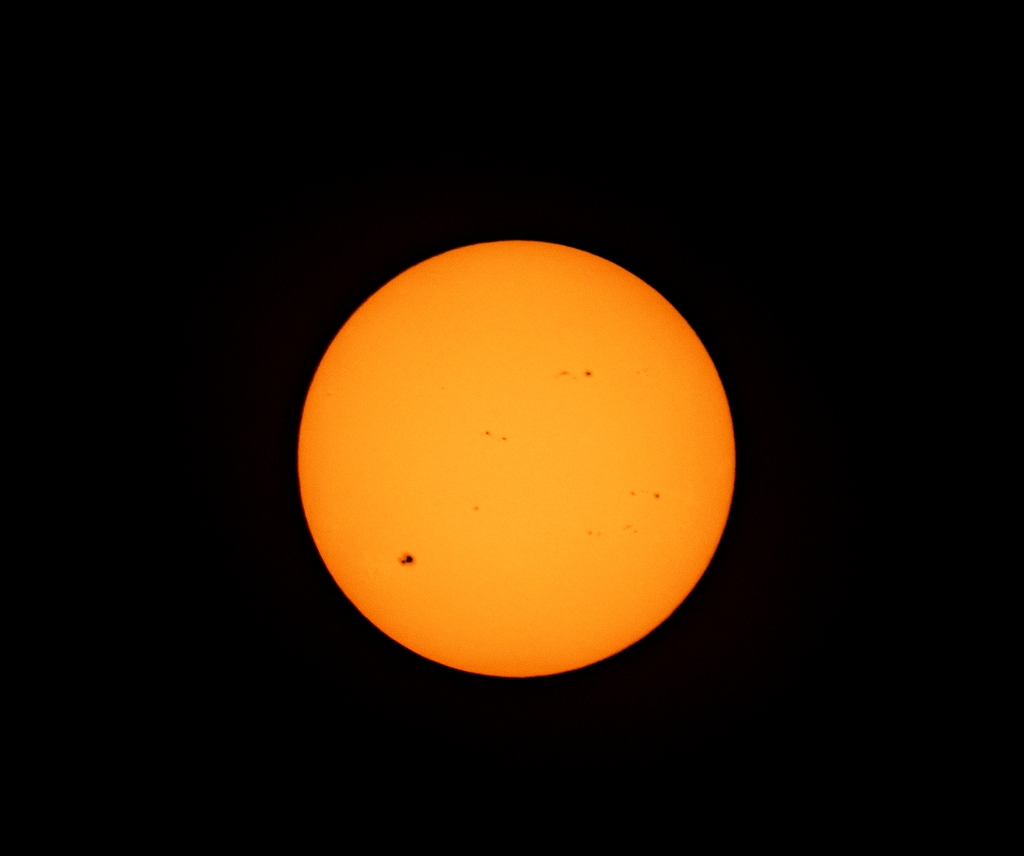
Out playing with my astro gear today in preparation for the Annular Solar Eclipse, visible in the western part of the country, in October. (Yeah, I know, that’s 4 months from now, but ya can’t be too ready when it comes to eclipses.) Between the clouds and trees, I imaged the sun from our back deck here in northeast Ohio. That huge sunspot in the lower left part of the picture is AR3363, as it’s affectionally known to scientists. It’s huge, 4 times larger than planet Earth. I missed one last week that was 11 times the size of Earth! If you saved your eclipse glasses from the August 2017 solar eclipse, you might try viewing this sunspot without a telescope. Do not, under any conditions, attempt to view the sun without using proper solar filters. It can, and will, blind you. The magnetic storms these puppies are kicking out are getting serious. Sunspots are caused by especially strong and intertwined magnetic fields. (And for the nerds among us, I made this image with my Explore Scientific ED80CF scope, Baader solar filter, and Nikon D7500. Single exposure.)
Well, it’s time for the Strawberry Moon—always something to look forward to. It’s the last full moon of spring or the first full moon of summer. This year it’s the former since June 3 is the day. This full moon (as with others) has any number of names. In this case, because its appearance is close to when wild strawberries ripen, not because of its color. Other names for this moon include the Hot Moon and the Honey Moon, not to be confused with a hot honeymoon.
The moon will be positioned low in the sky, and have a warmer appearance. The reason being, the moon needs to be directly opposite the sun to be full, and at this time of the year, when we’re pointed at the sun, the atmosphere is carrying a lot of moisture and pollutants that enhance the colors. A cool piece of astro trivia is that it will appear at approximately the same point in the sky where the sun will be in six months, or where it was six months ago.
Luna will appear full between Friday, June 3, through Monday, June 6. Get out and enjoy. Through binoculars or a small telescope, it will be quite bright. It won’t hurt your eyes, however, to see more detail, wear sunglasses to cut the glare. Yeah, neighbors will think you’re a bit “loony”, but that’s their loss.
A note about these two images: I’ve been experimenting with some new software and filters for astronomy and made these last night. The first closeup is not a true representation, but the color says strawberry. I left it tat color in post processing. The second image is made from a stack of about 20% of 2000 images registered and stacked in ASI stacking software, with post processing in LightRoom Classic. Both images made with an Explore Scientific 80ED triplet scope, AVX mount, and ASI224 camera.
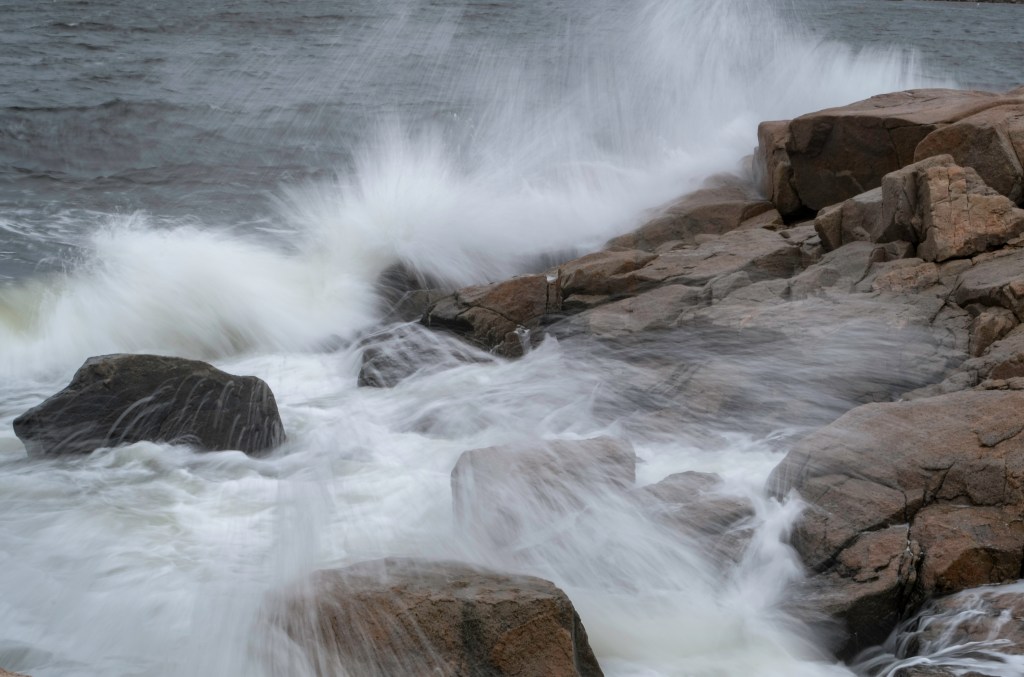
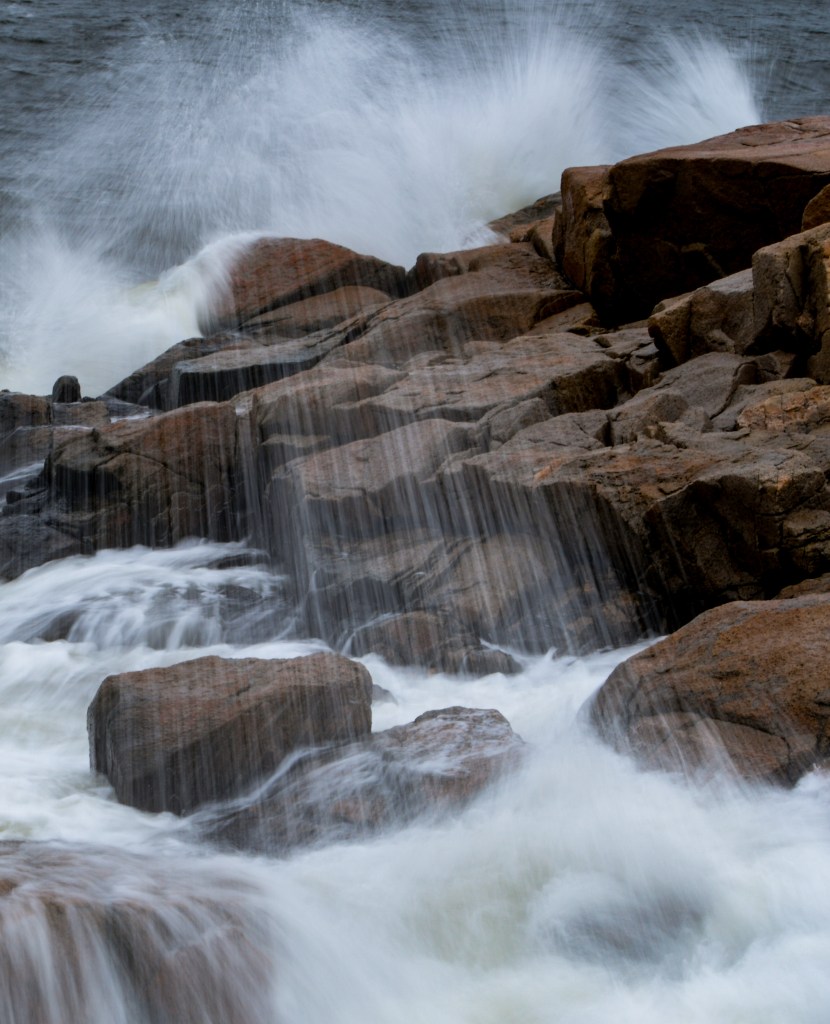
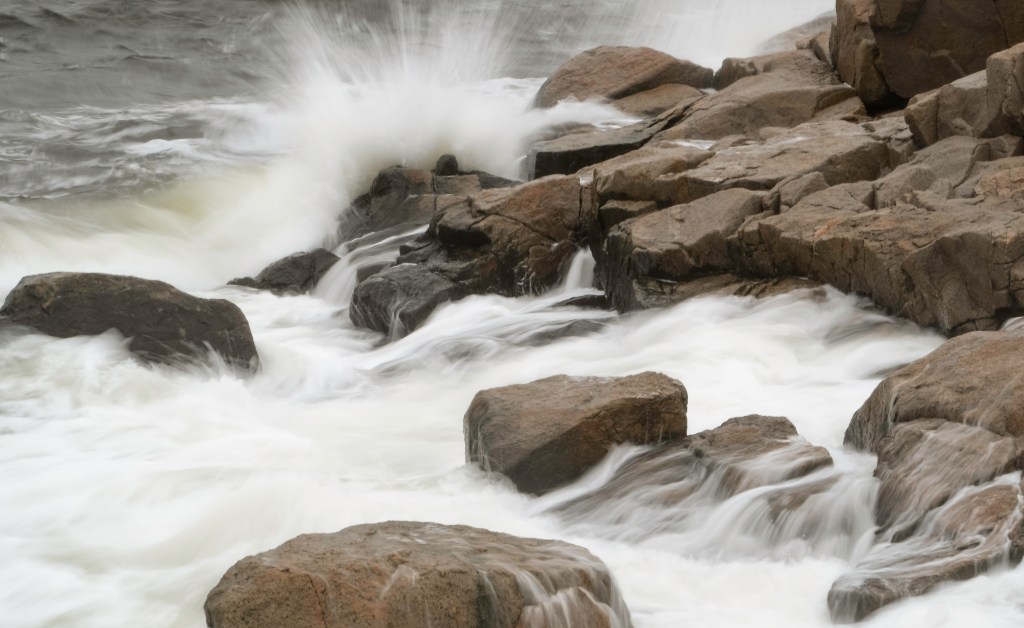
It was a grey and stormy morning–a neoclassic nor’easter. Wind coming at us straight from Greenland made the high tide even higher, but not tidier. It was the kind of morning when a second, or third, cup of coffee sounds like a good plan. On the other hand, if you have film developer still running through your veins from 50 years ago, the more harsh the conditions the more you feel the need to go out and see what’s what. As one of my heroes, Robert Capa, noted, if your pictures are no good you’re not close enough. Of course, he did die in Viet Nam when he stepped on a landmine.
Such was the case this morning in Annisquam, Massachusetts. I watched the waves for a bit and said, “I gotta get out there.” That was met with a resounding, “Don’t go out there on those slippery rocks!” I figured, better do it now before I’m too old. Others were thinking, “He’s too old to be doing this shit.”
Using my hand-held weather station, I clocked the wind at a steady twenty mpg, making the wind chill factor thirty-four degrees. Perfect. About 150 photos later, here are some results. I’m busy thawing my fingers, now.