
If you think all stars look alike (like skunks, for example), stay tuned. Speaking of skunks, last night’s encounter was a bit too close. I was working with one of my scopes, minding my own business, when Petunia, lady friend of Fred, walked within 12 inches of me, destined to get into the garage. Well, the profanity I used was not something you’d want your grandchildren (or Republicans) to hear. She looked at me and scampered back into the safety of Susan’s flower garden.
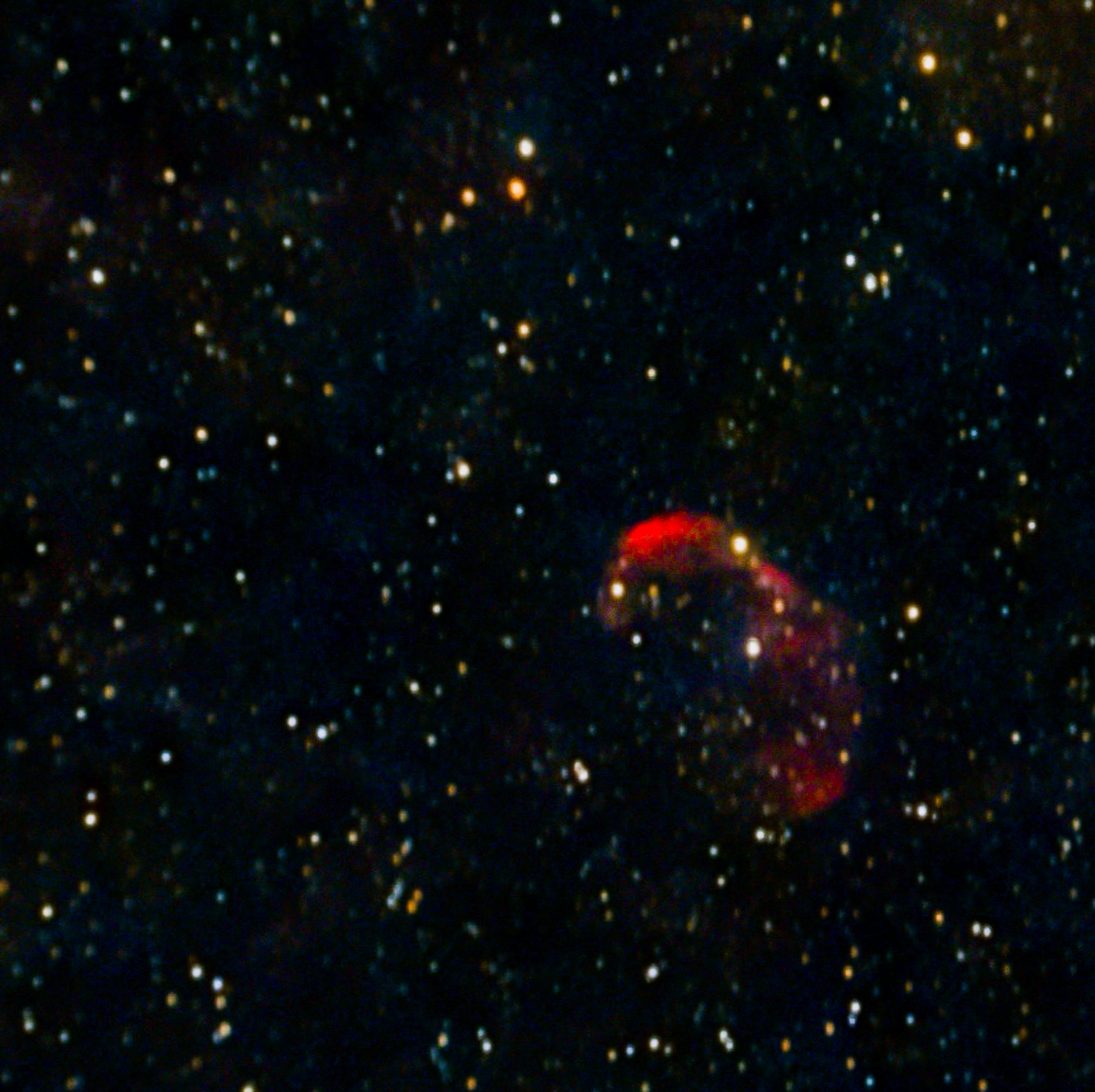
But let’s talk about stars—not just yet. The Crescent Nebula has just moved into my line of sight so I gave it a shot—not too accurately. It’s a great target that I’ll have to work on when conditions are better. Consider this a trailer (not to be confused with a preview). It’s an emission nebula, about 5,000 light years out, formed (primarily) by fast-moving solar wind colliding with slower moving wind ejected by the red giant star, Wolf-Rayet. The result of the collision is a shell and two shock waves—one moving out, the other moving in. Cool. (Pay attention ‘cause this will definitely be on the final exam.) (75 images stacked and processed in SeeStar 30)
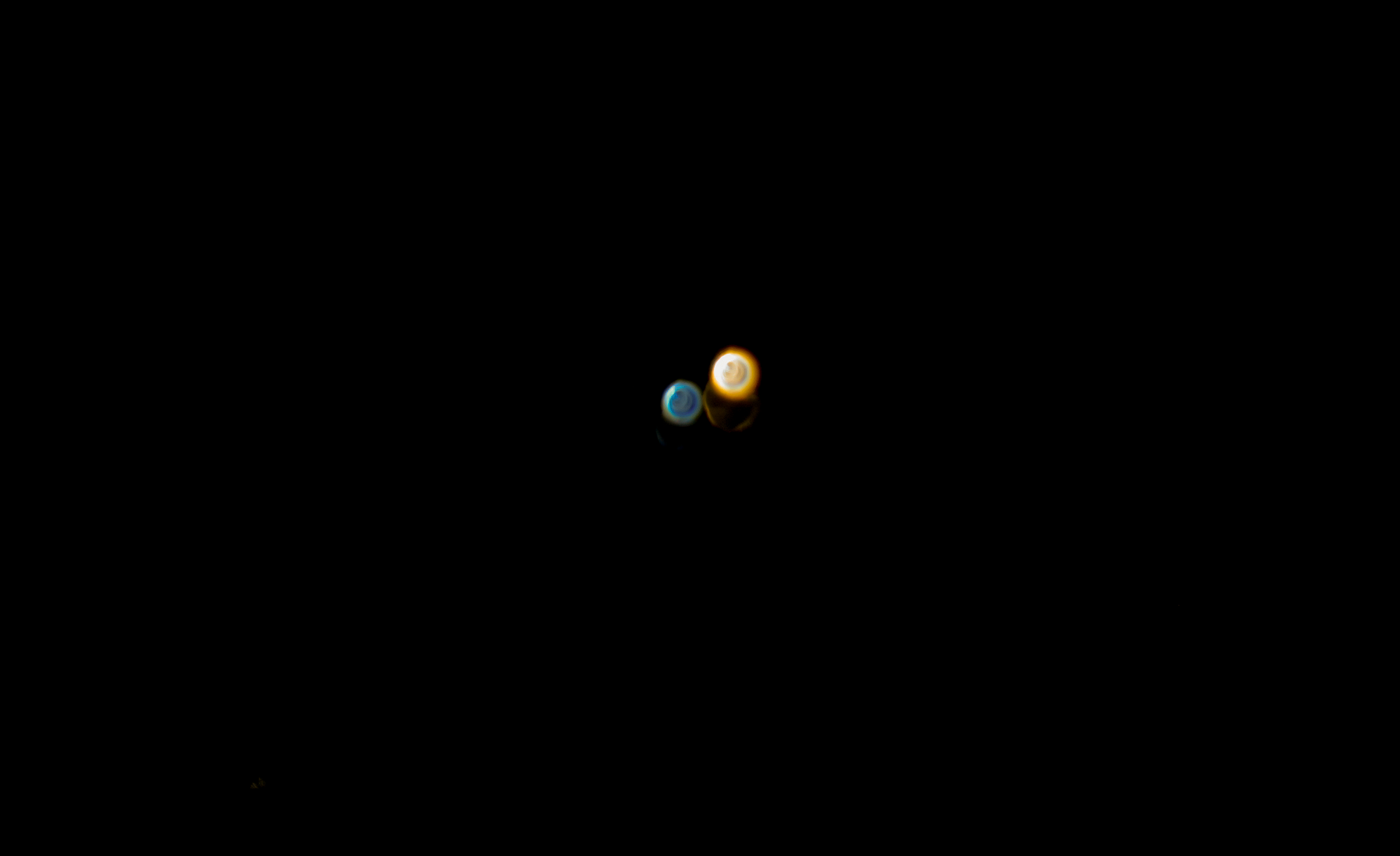
My primary target, and the reason I hauled out the big scope last night, was to image the beautiful star, Albireo (in the constellation of Cygnus if you’re looking). It’s listed as a double star, but here’s a pro tip—it’s really a quadruple! Cool. Albireo A (the gold one) is about 400 light years distant, as is Albireo B, the blue one. However, they are both binary systems, visually bound, not gravitationally bound. It takes about 120 years for the stars to orbit one another. Scientists are studying these stars and think that there might be three or four more stars involved that we just cannot see. For now, seeing this gold and azure combo shining out there (through a scope—not naked-eye visible from here) is a real treat. (11 images stacked, made with Celestron Evolution 8 and Nikon D850)


Leave a Reply