• Jumpin’ Jupiter

    There are billions of stars out there, however, it’s the planets that often attract people to the hobby of astronomy. And there are as many reasons for enjoying the views of distant planets as there are people doing the viewing. Saturn with its mysterious rings is always a favorite when people ask to look through my telescope. Mars and its reddish dust storms, the hazy blue color of Neptune.

    I enjoy Jupiter. It’s not only the largest planet in our solar system, one of its features is a storm, the Great Red Spot, that’s larger than our entire plant. And it has a host of moons, always changing position throughout the night. For amateurs with limited equipment and limited budgets, the planet’s details are tough to see, however, the position of its four primary moons is always visible, even with binoculars.

    Currently, the end of December, Jupiter is low in the southwestern sky as is Saturn. In fact, because of their orbits, they’ll appear very close; a conjunction astronomers call it. On December 21 they will appear to be a single star even though they are millions of miles apart. If you have a chance, get out just after sunset and take a look at these two gas giants. They’ve not appeared this close in 800 years and won’t line up again like this until 2080.

    Jupiter and four of her moons as seen December 10, 2020.
  • Mistakes Happen

    I do a fair amount of astro photography as an amateur astronomer and former professional photographer. Last evening, while setting up my telescope and equipment, I glanced up at the slice of a moon and saw the International Space Station coming my way. Immediately, I realized the path of ISS would pass close to the moon (separated by thousands of miles, of course). I grabbed my camera, which was sitting on a nearby table and started shooting. I had no idea what the camera was set for since Susan and I had been out the previous day making pictures of birds. I could tell from the sound of the slow shutter that I was going to get some blurred images. When I looked at the image of the moon and the ISS I was pleasantly surprised to see that, while a bit blurry, the shaky camera unintentionally produced an image that looks a lot like the ISS. I’ve consciously tried to photograph ISS over the years and never had success. This grab-shot mistake is as good as it gets, sometimes.

  • It’s On The Shelf!

    The new novel has landed! Or, dropped as the current phrase would have it. Here’s the link that will take you directly to the book store at BookBaby.com, my publisher. https://store.bookbaby.com/book/all-maps-are-fiction. Currently, the book (paperback or eBook) is only available in their store because of production requirements and restrictions. It will be available at Amazon and most bookstores, worldwide, after the first of the new year. Enjoy the read, write a review, or drop me a line.

  • Still Here

    I’m not sure which cliche to use; I’ve been so busy I don’t have time to do anything (sorry, Yogi), or, Report of my death is greatly exaggerated–Mark Twain. In either case, I’ve been away from the blog-o-sphere for too long and plan to remedy that. I find it hard to believe that it’s been more than a year since I’ve posted anything. I’ve had many conversations with the voices in my head, which I thought ended on the page. Not so, I guess.

    Let’s think of this as spring training–although, as a Cleveland-area guy, I promise not to talk about sports. Birding and fishing remain my passions, and you can add astronomy to that mix. Here are a couple of trailers (When did trailers, a word that connotes something at the end, replace the word preview, a word that connotes something to come?) to whet your appetite.

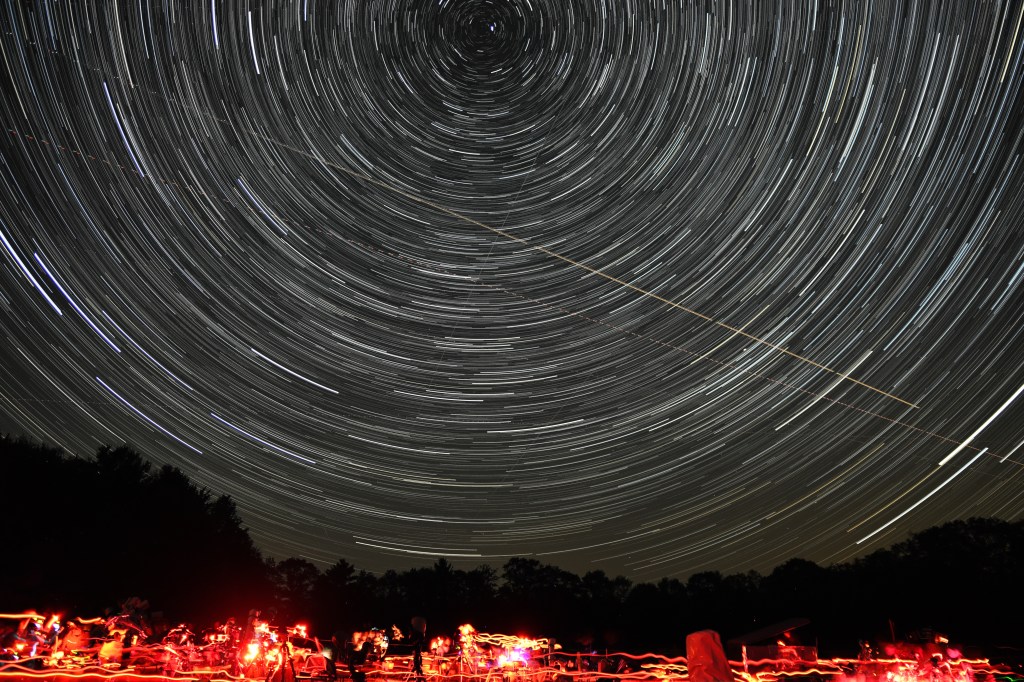
    Susan and I will be heading to Alaska for a few weeks at the end of May (Can’t miss spring migration here!) in hopes of seeing birds such as the Bristle-thighed Curlew (Eskimo Curlew is only a dream bird) and the Bluethroat. Stay tuned. Last summer I went to MARS, Maine Astronomy Retreat and Symposia, (summer camp for adults hooked on stars) and will be going back this August. Here’s an image I made, with the help of Babak Tafreshi, a photographer for National Geographic magazine, at the camp.

  • Mysteries of Spring

    Okay, I know we’re a few days from the start of Winter, not Spring, however, last night we were at a going-away party for a friend and I thought of blog I wrote a dozen years ago in which she was the protagonist. We joked about the event and when I read it this morning I realized how memories can change the reality of things. Sort of that alternate truth stuff we get out of the nation’s capital these days.

    9 April 2006

    Mysteries of Spring

    Susan and I went for an early spring bird walk with our favorite naturalist, Wendy, to our favorite spot in the Cuyahoga Valley National Park. We call the spot Warbler Ridge. Don’t look at the map, you’ll not find the name. We gave it that designation years ago after a great day of birding there.

    The real benefit of birding with a naturalist, as opposed to an ornithologist, is that she makes you look at things other than the birds—the ground for instance.

    This spot is a bit off the trail and I suppose, if everyone strayed from the straight and narrow path, the place would begin to look like downtown Cleveland. However, we try to walk gentle on the land.

    While watching where to put my feet and looking for wildflowers, I was stunned to see the corner of a $20 bill peeking out of the grass! On closer inspection we realized the bill was part of a field mouse’s nest. I gently removed the $20. One small nibble in the corner—not even as much deterioration as inflation—was the only damage.

    How did a $20 bill get out here? We looked around for more. Nope, just the one and no sign of the mouse, either.

    Who says birding doesn’t pay?

  • We Coulda Gone Shopping


    Thanksgiving tends to be a time for nostalgia. As conversation around the dinner table edged toward what we did in the past on this day, I thought of Thanksgiving 2014 when Susan and I, along with our birding buddies, ventured to the coast of South Carolina for a few day so birding. Here’s how the trip went:

    Birding buddies Pat and Karin, along with Susan and I, opted to do something different. We headed to South Carolina for some serious birding–well, as serious as it gets for us. The impetus for this adventure was the fact that Pat had visited every state in the union except South Carolina; reason enough for an adventure. We’d heard and read lots of good things about birding the area around Huntington Beach State Park, it was a holiday and campsites were available. So what’s not to like?

    Twenty-three hundred miles and 100-plus species later, I can tell you it was one great trip, assuming you like seeing thousands of perfectly choreographed Black Skimmers in flight, Wood Storks fishing 25 feet from you, and one of the more endangered birds on the plant, Red Knots, 57 of them, feeding like there’s no tomorrow–and for them, that might be the case.

    Okay, so maybe sleeping on the ground when temperatures are a balmy 29 degrees is not for everyone. For us, the rustic tent sites (that’s what they were called) were perfect for our week-long adventure. Although there were many other spots to bird in the region, we found the Huntington Beach area most attractive. The joy of romantic, long walks on the beach lugging tons of spotting scopes, camera gear and day packs filled with almost-nutritious snacks are the things birders look forward to. Susan and I needed time to relax and unwind from the stresses of being retired, ya know. Youngsters Pat and Karin do have jobs so I guess it was relaxing for them, too.

    There were many highlights during this trip; good and not-so-good restaurants, Great Horned Owls serenading while setting up the tent the first day, and happening upon a small group of Wood Storks feeding close to the road on our way out the last day.

    Of ornithological importance was Pat’s early Friday morning sighting and identification of a group of Red Knots. He returned to camp with the news and we flocked (that’s what birders do) to the beach. We were able to get close enough to the birds to read the leg tags on several, even to see a tracking device on one bird.

    Seventy-five percent of the birders in our group of four are not as addicted to listing as me. So I have to toss in the fact that I saw life bird (lower 48 states, no pelagic trips) number 606, a Purple Sandpiper. Again, the high-five for that one goes out to sharp-eyed Pat who spotted it loafing within a group of about 100+ Dunlin, a quarter mile away. Any questions about why we enjoy birding with Pat and Karin?

    Happy not to see a television ad or a big box store for a week, made each birding highlight shine a bit brighter. I think only one or two dozen times a day did any of us say, “Well, we coulda gone shopping.”
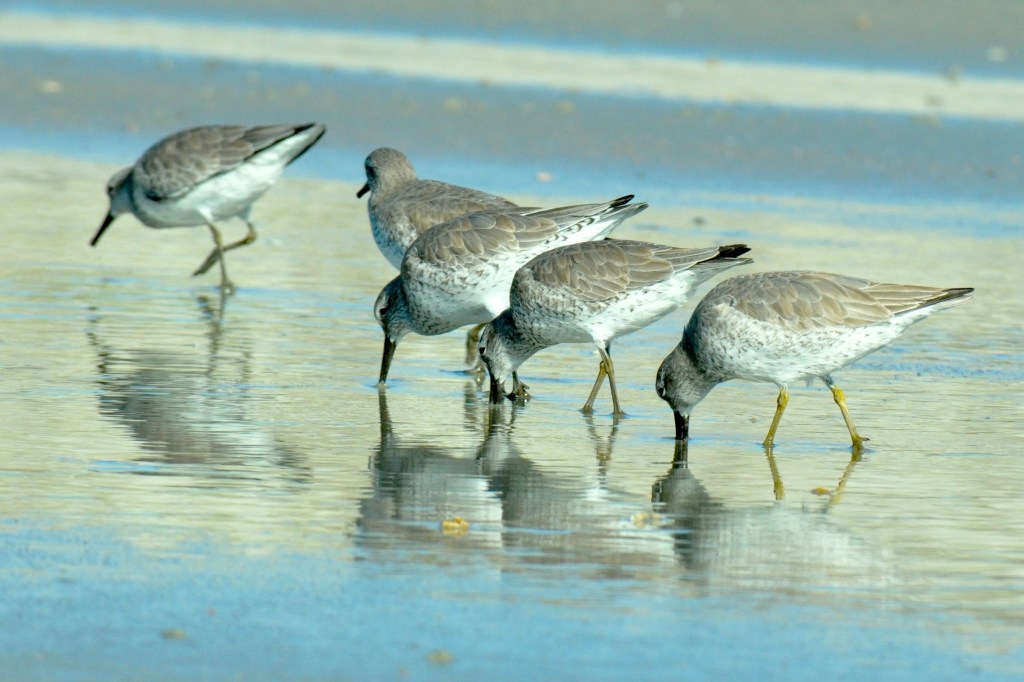
    Endangered Red Knots, Huntington, South Carolina, State Park
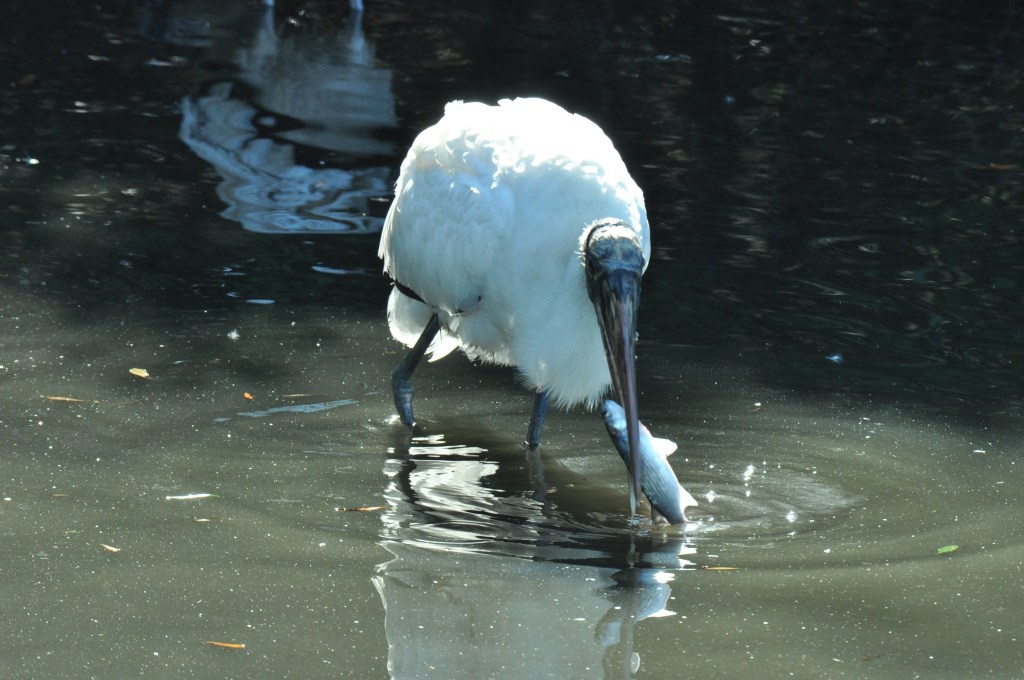
    Wood Stork having fish for liunch